
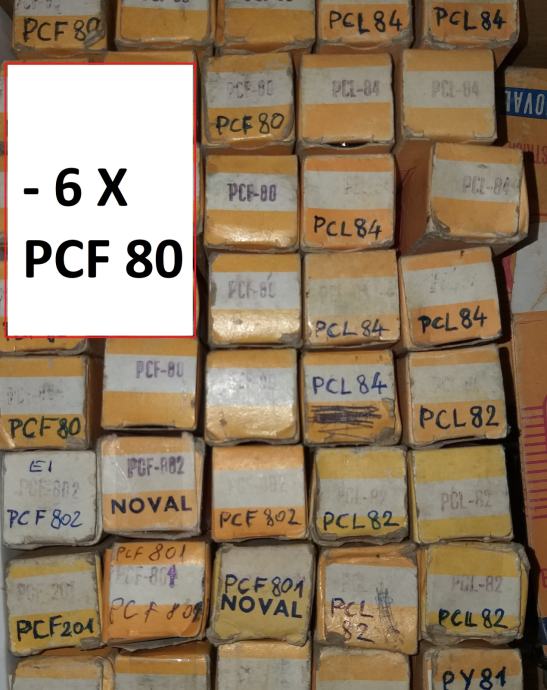
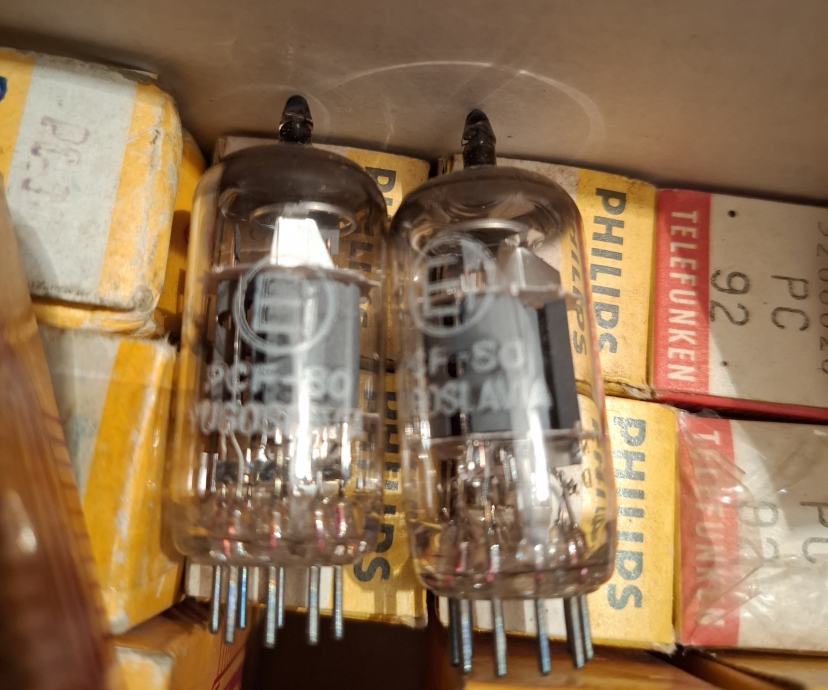
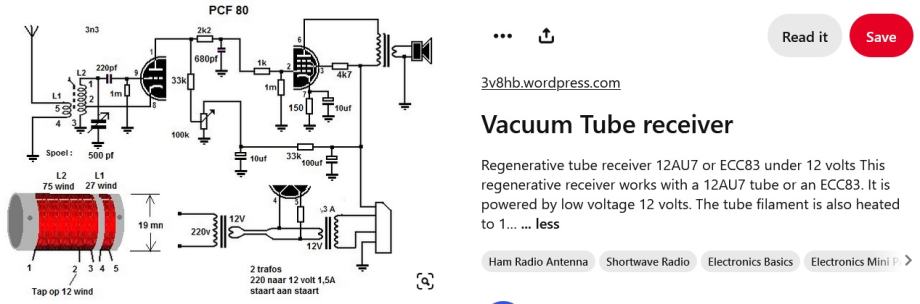


PCF80 ( 6BL8 = 6Ф1П = CV5215 = ECF80 ) 2x elektronka Ei Niš
- Cena
- 22 €
Šifra oglasa: 14782841
Osnovne informacije
- Vrsta ponudbe
- Prodam
- Lokacija
- Posavska, Brežice, Brežice
- Proizvajalec
- Philips
- Diagonala zaslona (v palcih)
- 55
- Stanje
- novo
Opis oglasa
2 novi elektronki PCF80, 22 eur
Še link do zanimive strani:
https://www.cool386.com/6BL8/6BL8.html
Any Australian who collects valves or is into vintage television will have copious quantities of 6BL8's. Sadly, they are usually regarded as worthless (and in the radio world, useless). Yet, they are one of the most versatile valves, usable in so many applications.
The 6BL8 is a 9 pin triode pentode, rated for VHF operation. It was originally designed by Philips for use as a TV tuner frequency converter, with the triode as the local oscillator, and the pentode as the mixer. Probably unbeknown to most Australians, the 6BL8 started life as the PCF80. This is a far more common valve in Europe and the UK, since series heater TV sets were standard there. This article will therefore also be of use to readers from Europe and Britain.
Prior to the PCF80, Philips had been using the ECC81/12AT7 in their TV tuners, as the frequency converter. In 1954, the PCF80 became available, providing superior performance in this role.
Designed for European television receivers, the PCF80 was intended for 300mA series heater circuits. The heater voltage is 9V. In the RMA valve numbering system, this valve is known as the 9A8. Curiously, this valve also appears as an 8A8, despite the 9V heater.
Another less common variation is the LCF80/6LN8. This is specifically for 450mA series heater circuits, and was used in some Japanese TV sets.
Since transformer isolated power supplies were standard in Australia, the PCF80 was also available with a 6.3V heater, as type ECF80. In Australia, the ECF80 is more widely known under the RMA type number, 6BL8. Depending on the data, the heater current at 6.3V is shown as either 430mA or 450mA. Despite 450mA being a standard heater current in some series circuits, the 6BL8 is not designed for series heater use.
When TV started in Australia, in 1956, the 6BL8 found itself in just about every set that was not based on U.S. designs. Most commonly, it was used in the Philips tuner, type AT7580, and the later version, type NT3001. These tuners were used in many sets; not just Philips. Beyond that, the 6BL8 was also used for line oscillators, sync separators, IF amplifiers, AGC circuits, and in fact anywhere that a signal type pentode and/or triode was required.
Outside of television use, the 6BL8 also appeared in test instruments, such as oscilloscopes and voltmeters. No commercially made domestic radio receivers are known to have used it in Australia, but it was used in FM receiver front ends in Europe and Britain.
In the U.S., the 6BL8 did find limited use, particularly in some colour TV's during the 1960's, but in that country, a similar valve, the 6U8, was the dominant signal type triode pentode.
Še link do zanimive strani:
https://www.cool386.com/6BL8/6BL8.html
Any Australian who collects valves or is into vintage television will have copious quantities of 6BL8's. Sadly, they are usually regarded as worthless (and in the radio world, useless). Yet, they are one of the most versatile valves, usable in so many applications.
The 6BL8 is a 9 pin triode pentode, rated for VHF operation. It was originally designed by Philips for use as a TV tuner frequency converter, with the triode as the local oscillator, and the pentode as the mixer. Probably unbeknown to most Australians, the 6BL8 started life as the PCF80. This is a far more common valve in Europe and the UK, since series heater TV sets were standard there. This article will therefore also be of use to readers from Europe and Britain.
Prior to the PCF80, Philips had been using the ECC81/12AT7 in their TV tuners, as the frequency converter. In 1954, the PCF80 became available, providing superior performance in this role.
Designed for European television receivers, the PCF80 was intended for 300mA series heater circuits. The heater voltage is 9V. In the RMA valve numbering system, this valve is known as the 9A8. Curiously, this valve also appears as an 8A8, despite the 9V heater.
Another less common variation is the LCF80/6LN8. This is specifically for 450mA series heater circuits, and was used in some Japanese TV sets.
Since transformer isolated power supplies were standard in Australia, the PCF80 was also available with a 6.3V heater, as type ECF80. In Australia, the ECF80 is more widely known under the RMA type number, 6BL8. Depending on the data, the heater current at 6.3V is shown as either 430mA or 450mA. Despite 450mA being a standard heater current in some series circuits, the 6BL8 is not designed for series heater use.
When TV started in Australia, in 1956, the 6BL8 found itself in just about every set that was not based on U.S. designs. Most commonly, it was used in the Philips tuner, type AT7580, and the later version, type NT3001. These tuners were used in many sets; not just Philips. Beyond that, the 6BL8 was also used for line oscillators, sync separators, IF amplifiers, AGC circuits, and in fact anywhere that a signal type pentode and/or triode was required.
Outside of television use, the 6BL8 also appeared in test instruments, such as oscilloscopes and voltmeters. No commercially made domestic radio receivers are known to have used it in Australia, but it was used in FM receiver front ends in Europe and Britain.
In the U.S., the 6BL8 did find limited use, particularly in some colour TV's during the 1960's, but in that country, a similar valve, the 6U8, was the dominant signal type triode pentode.
Zemljevid
gregor2014
Vsi oglasi tega oglaševalca
Uporabnik je telefonsko številko preveril v državi Slovenija
Uporabnik ni trgovec in zanj ne veljajo določbe EU o varstvu potrošnikov.
- Naslov: 8000 novo mesto, Osrednjeslovenska, Slovenija
- Oglas je objavljen
- 08.12.2025. ob 09:09
- Do poteka še
- Oglas je prikazan
- 905 -krat
gregor2014
Vsi oglasi tega oglaševalca
Uporabnik je telefonsko številko preveril v državi Slovenija
Uporabnik ni trgovec in zanj ne veljajo določbe EU o varstvu potrošnikov.
- Naslov: 8000 novo mesto, Osrednjeslovenska, Slovenija