

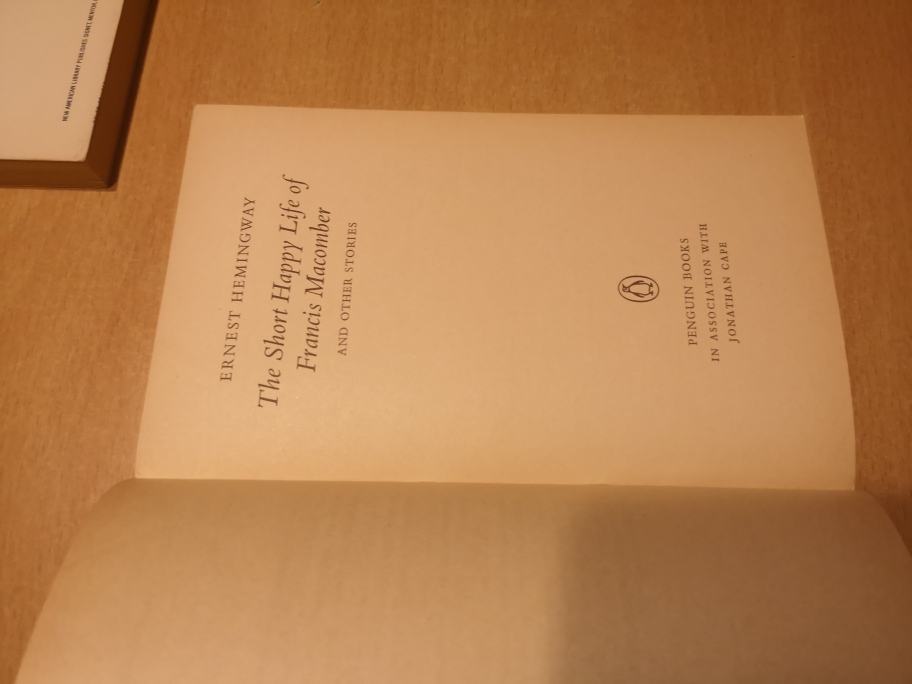
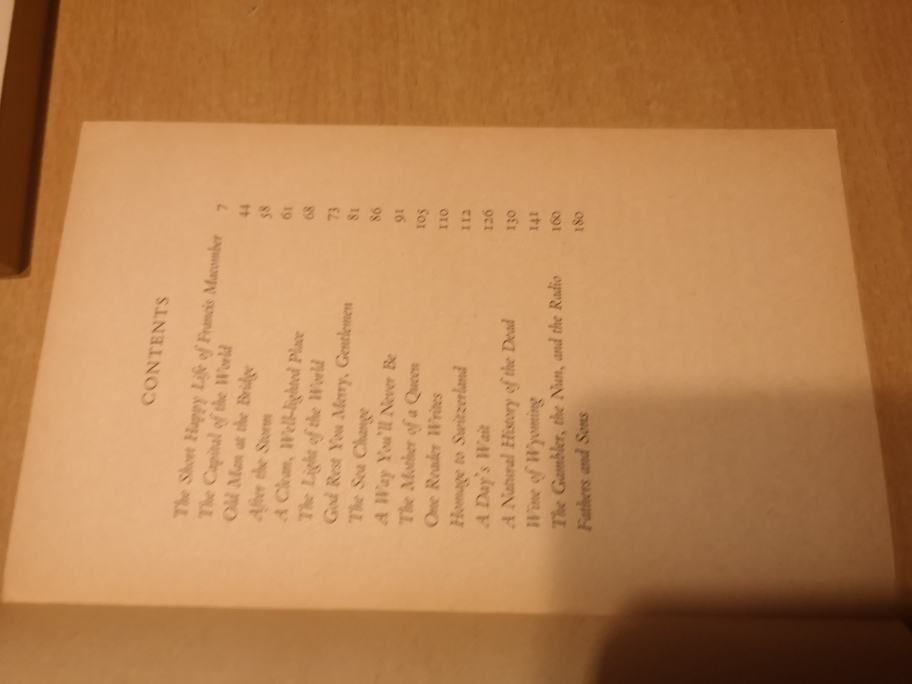
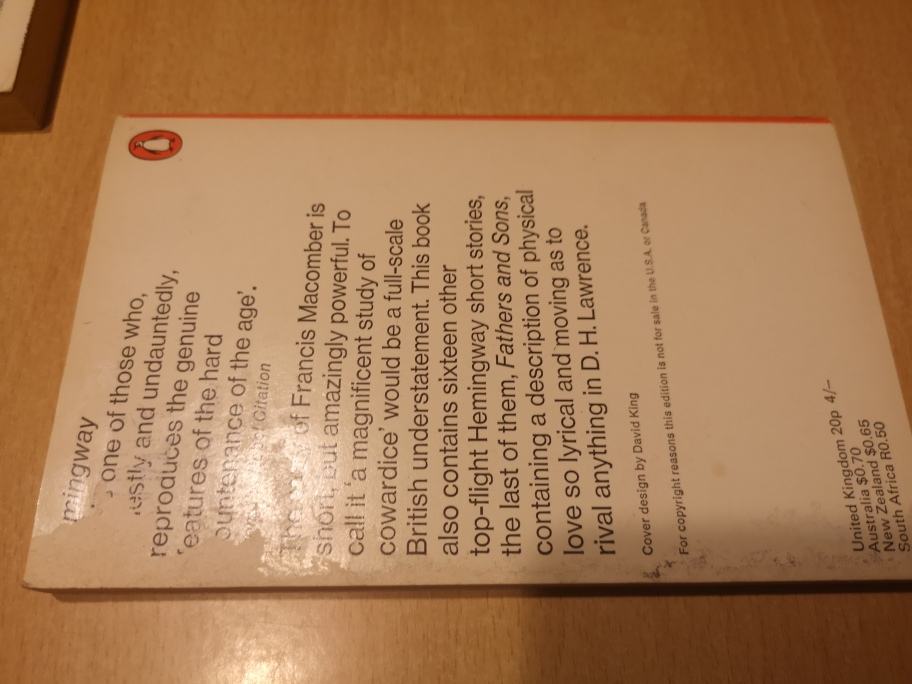


The Short Happy Life of Francis Macomber short story by Hemingway
- Cena
- 5 €
+ zaščita kupca 0,99 €
+ dostava 0,00 €
Brez skrbi, poštnino častimo mi!
Izkoristi promocijsko obdobje.

Plačaj varno in enostavno z Google ali Apple pay.
Storitev BREZ SKRBI - Denar za izdelek nakažete na nevtralni račun bolha.com. Če prejeti izdelek ni enak naročenemu ali izdelek ni bil dostavljen, vam vrnemo denar. Pred naročanjem pozorno preberite Navodila in pogosta vprašanja.
Šifra oglasa: 4892057
Osnovne informacije
- Lokacija
- Posavska, Brežice, Jesenice na Dolenjskem
- Stanje
- rabljeno
Opis oglasa
KNJIGA JE V ANGLEŠKEM JEZIKU.ŽEPNA IZDAJA,,,MEHKE PLATNICE
LEPO OHRANJENO,OB NAKUPU VSAJ TREH KNJIG IZ ŠE OSTALIH OGLASOV IN PLAČILU NA TRR JE
POŠTNINA B R E Z P L A Č N A
LOK- K1D
KLASIKI,ANGLEŠKA KNJIŽEVNOST,BESTSELLER,LITERARNE ŠTUDIJE
The Short Happy Life of Francis Macomber
short story by Hemingway
"The Short Happy Life of Francis Macomber" is a third-person omniscient narrative with moments of unreliable interior monologue presented mainly through the points of view of the two leading, male characters, Francis Macomber and Robert Wilson, professional hunter and guide. Francis and his wife, Margot, are on a big-game safari in generalized Africa. Earlier, Francis had panicked when a wounded lion charged him, and Margot mocks Macomber for this act of cowardice. Wilson is critical of Macomber, presented in interior monologue, but outwardly tries to shepherd Macomber toward a more accepted "code" practiced by experienced hunters. This is Francis' thirty-five-year-old "coming of age" story.
In flashback, we experience Francis' cowardly run from his wounded and charging lion. We also learn of Margot's adultery, punctuated by sleeping with Wilson the night after Francis' cowardly run. Wilson both kills Francis' wounded lion and has sex with his unhappy wife. Macomber both hates and needs Wilson in spite of this. As Wilson puts it, this is Francis' chance to come of age, to become a man. Note: Throughout the narrative, both Francis and Wilson have repeated moments of interior monologue; internal and highly critical thoughts about each other and Margot are repeatedly expressed. Rarely is Margot given an internal monologue, and when it is allowed, it blurs with the narrator’s. Her motivations are more often narrated by Wilson, who thinks very little of her, except for her beauty, choosing a man she can control and her sexuality when she is quiet. Her spoken dialogue is often condescending and minimized by both Macomber and Wilson. Like the trophy prey they hunt, Margot's expressiveness is cast by her audibility and visuality. Margot’s characterization centers on the “femme-fatale” paradigm—the beautiful, sexual, adulterous and murdering wife. Ironic, as she is Francis’ trophy wife and married Francis for his wealth.
The next day the party hunts buffalo. Macomber and Wilson hunt together and shoot three buffalo. Two of the buffalo are killed, but the first is only wounded and retreats into the bush. Macomber now feels confident. All three drink whisky in celebration. Margot shows anger for Francis' kill and transition from fear into confidence. Wilson senses a shift in her viewpoint toward her husband: in his point of view, she now fears her husband's growing confidence. Wilson is proud of Francis and feels his job is done. He has helped Francis stand up to his adulterous wife and has helped him kill a buffalo. At no time does Wilson take responsibility for his part in the adultery. He provides a double cot in his tent in order to provide better service to women who feel a safari is not complete without sleeping with the "great white hunter"; he is merely satisfying men and women's glorification of him as "the white hunter."
The gun-bearers report that the first buffalo has not died and has gone into the tall grass. Wilson refocuses on Macomber and helps him track the wounded buffalo, paralleling the circumstances of the previous day's lion hunt. Macomber, however, is confident this time, courageous. Wilson is, again, proud.
When they find the buffalo, it charges Macomber. He stands his ground and fires at it, but his shots are too high. Wilson fires at the beast as well, but it keeps charging. At the same time, Margot fires a shot from the car, which hits Macomber in the skull and kills him, as narrated by the omniscient narrator: “… and Mrs. Macomber, in the car, had shot at the buffalo with the 6.5 Mannlicher as it seemed about to gore Macomber and had hit her husband about two inches up and a little to one side of the base of his skull …
Kratko srečno življenje Francisa Macomberja , kratka zgodba Ernesta Hemingwaya, prvič objavljena v časopisu Cosmopolitan leta 1936, zbrana v Peti stolpcu in prvih devetinštiridesetih zgodbah (1938). Zgodba je postavljena na afriški safari in vsebuje nekaj avtorjevih ponavljajočih se tem - "milost pod pritiskom" in spoštovanje moškega kodeksa vedenja. Znan je tudi po svoji dvoumni upodobitvi čustev in motivacij. Lik Francis Macomber, bogati Američan
LEPO OHRANJENO,OB NAKUPU VSAJ TREH KNJIG IZ ŠE OSTALIH OGLASOV IN PLAČILU NA TRR JE
POŠTNINA B R E Z P L A Č N A
LOK- K1D
KLASIKI,ANGLEŠKA KNJIŽEVNOST,BESTSELLER,LITERARNE ŠTUDIJE
The Short Happy Life of Francis Macomber
short story by Hemingway
"The Short Happy Life of Francis Macomber" is a third-person omniscient narrative with moments of unreliable interior monologue presented mainly through the points of view of the two leading, male characters, Francis Macomber and Robert Wilson, professional hunter and guide. Francis and his wife, Margot, are on a big-game safari in generalized Africa. Earlier, Francis had panicked when a wounded lion charged him, and Margot mocks Macomber for this act of cowardice. Wilson is critical of Macomber, presented in interior monologue, but outwardly tries to shepherd Macomber toward a more accepted "code" practiced by experienced hunters. This is Francis' thirty-five-year-old "coming of age" story.
In flashback, we experience Francis' cowardly run from his wounded and charging lion. We also learn of Margot's adultery, punctuated by sleeping with Wilson the night after Francis' cowardly run. Wilson both kills Francis' wounded lion and has sex with his unhappy wife. Macomber both hates and needs Wilson in spite of this. As Wilson puts it, this is Francis' chance to come of age, to become a man. Note: Throughout the narrative, both Francis and Wilson have repeated moments of interior monologue; internal and highly critical thoughts about each other and Margot are repeatedly expressed. Rarely is Margot given an internal monologue, and when it is allowed, it blurs with the narrator’s. Her motivations are more often narrated by Wilson, who thinks very little of her, except for her beauty, choosing a man she can control and her sexuality when she is quiet. Her spoken dialogue is often condescending and minimized by both Macomber and Wilson. Like the trophy prey they hunt, Margot's expressiveness is cast by her audibility and visuality. Margot’s characterization centers on the “femme-fatale” paradigm—the beautiful, sexual, adulterous and murdering wife. Ironic, as she is Francis’ trophy wife and married Francis for his wealth.
The next day the party hunts buffalo. Macomber and Wilson hunt together and shoot three buffalo. Two of the buffalo are killed, but the first is only wounded and retreats into the bush. Macomber now feels confident. All three drink whisky in celebration. Margot shows anger for Francis' kill and transition from fear into confidence. Wilson senses a shift in her viewpoint toward her husband: in his point of view, she now fears her husband's growing confidence. Wilson is proud of Francis and feels his job is done. He has helped Francis stand up to his adulterous wife and has helped him kill a buffalo. At no time does Wilson take responsibility for his part in the adultery. He provides a double cot in his tent in order to provide better service to women who feel a safari is not complete without sleeping with the "great white hunter"; he is merely satisfying men and women's glorification of him as "the white hunter."
The gun-bearers report that the first buffalo has not died and has gone into the tall grass. Wilson refocuses on Macomber and helps him track the wounded buffalo, paralleling the circumstances of the previous day's lion hunt. Macomber, however, is confident this time, courageous. Wilson is, again, proud.
When they find the buffalo, it charges Macomber. He stands his ground and fires at it, but his shots are too high. Wilson fires at the beast as well, but it keeps charging. At the same time, Margot fires a shot from the car, which hits Macomber in the skull and kills him, as narrated by the omniscient narrator: “… and Mrs. Macomber, in the car, had shot at the buffalo with the 6.5 Mannlicher as it seemed about to gore Macomber and had hit her husband about two inches up and a little to one side of the base of his skull …
Kratko srečno življenje Francisa Macomberja , kratka zgodba Ernesta Hemingwaya, prvič objavljena v časopisu Cosmopolitan leta 1936, zbrana v Peti stolpcu in prvih devetinštiridesetih zgodbah (1938). Zgodba je postavljena na afriški safari in vsebuje nekaj avtorjevih ponavljajočih se tem - "milost pod pritiskom" in spoštovanje moškega kodeksa vedenja. Znan je tudi po svoji dvoumni upodobitvi čustev in motivacij. Lik Francis Macomber, bogati Američan
Zemljevid
Opomba: prikaže se približna lokacija vašega oglasa
mitjah13
Uporabnik je telefonsko številko preveril v državi Slovenija
Uporabnik ni trgovec in zanj ne veljajo določbe EU o varstvu potrošnikov.
- Naslov: 8261 Jesenice na dolenjskem, Posavska, Slovenija
- Oglas je objavljen
- 27.11.2025. ob 14:03
- Do poteka še
- Oglas je prikazan
- 862 -krat
mitjah13
Uporabnik je telefonsko številko preveril v državi Slovenija
Uporabnik ni trgovec in zanj ne veljajo določbe EU o varstvu potrošnikov.
- Naslov: 8261 Jesenice na dolenjskem, Posavska, Slovenija